

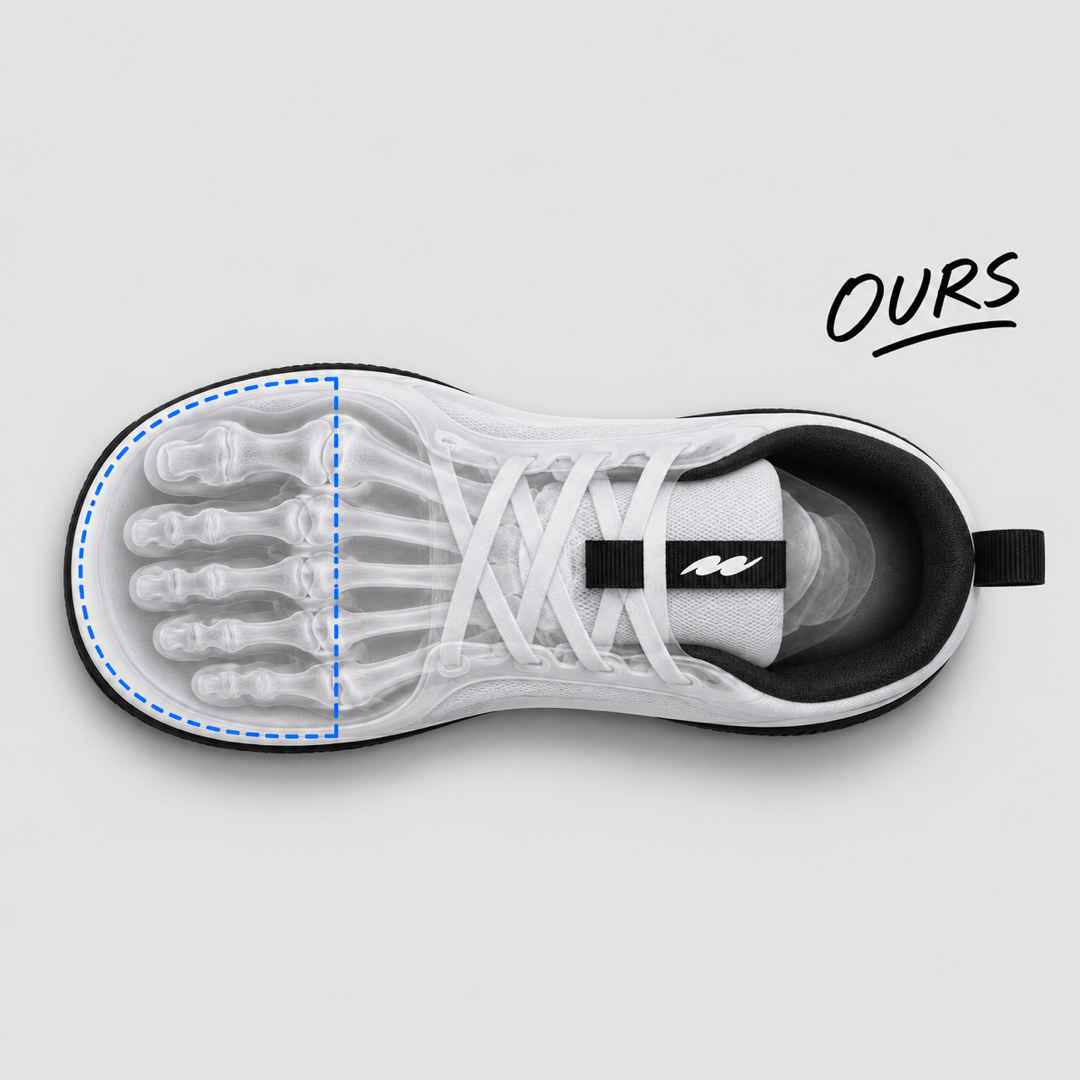
Why a wide toe box matters
Your toes are the widest part of your foot. Here's what giving them room does for your balance, your stops and your toenails.
What "drop" means, what changes when your heel comes down, how it can help your game, what the research says and how to make the switch without the soreness.
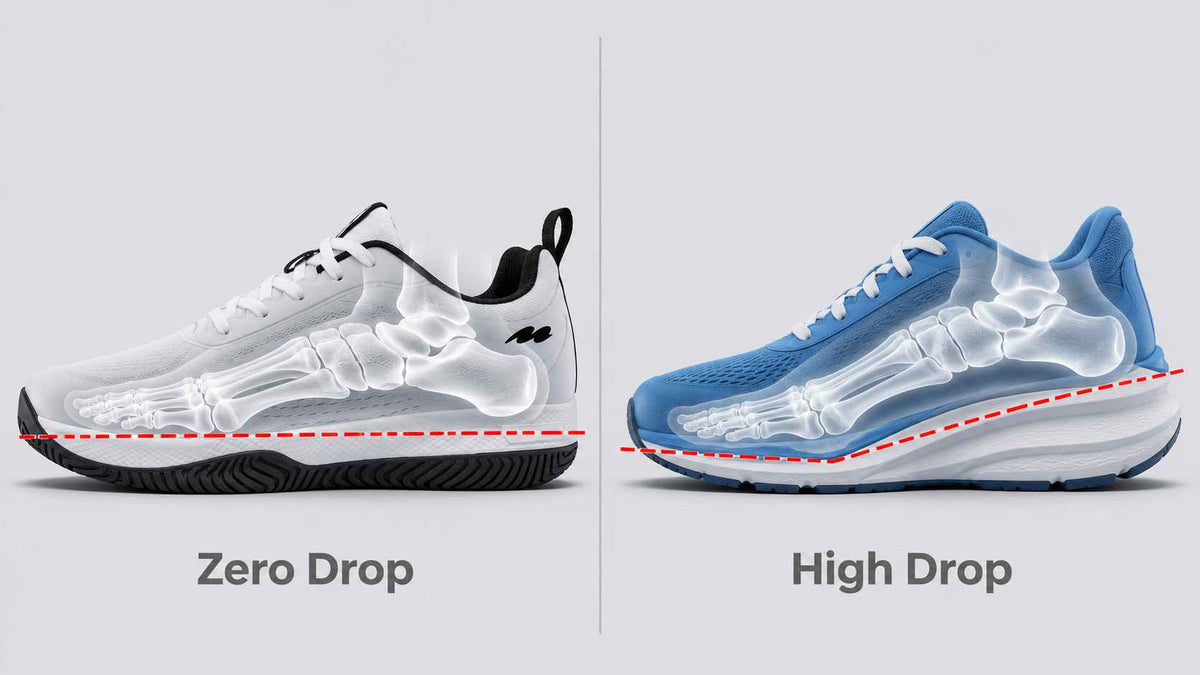
Drop is the height difference between the heel and the front of a shoe, measured in millimeters.
Most court shoes lift your heel. That idea comes from running, where a raised heel softens landing on your heel. But on court you play on the balls of your feet.
A raised heel does part of your calves' work for them: the higher the heel, the shorter your calf muscle works (see the study). Other brands add stiffer support too, and research suggests that can leave your foot muscles with less to do (see the study).
That's the difference. Other brands build the shoe to do the work for your feet. We build it so your feet do the work, because we want them to train every time you play. So we did the opposite:
That's why the first weeks feel different, and why you should build up slowly.
Your feet are stronger than your shoes let them be. Take away the ramp and your feet and calves get their job back. Here's what that can mean for you:
Your calves and Achilles work through their full natural length, and the small muscles in your feet stay active to keep you balanced on every stop and split step. Many players notice their feet feel stronger and more stable over time.
A raised heel keeps your calves slightly shortened. University of Texas at Austin researchers found the higher the heel, the shorter the calf muscle works, and the more energy runners used (see the study).
Without a raised heel, your weight isn't tipped onto your toes.
Barefoot, your heel and toes sit on the same level. Zero drop keeps that position, which helps your body sense where it is on quick moves.
Without a heel wedge, your foot and ankle move more naturally, for a quicker, more responsive first step.
Research from the University of Virginia suggests raised heels change how forces move through your knee (see the study). A level shoe lets your legs move the way they're built to.
If you've worn shoes with a raised heel for years, your calves and Achilles have gotten used to a shortened position. Zero drop asks them to lengthen and work a bit harder, and asks the muscles in your feet to do more of the work your old shoes did for them.
That's the same demand that makes your feet stronger. In the first weeks you may notice:
Studies show that people with stronger, healthier feet report less foot pain and stay more active as they age (see the study)
Week 1
Start with about 10 minutes a day. Add a little each day if you feel fine the next morning. Short walks; a few easy rallies late in the week
Week 2
Longer wear and walks; 30–60 min social games.
Week 3
Full sessions, competitive games and drills
after Week 4
Don't be surprised if your partners start asking how you're still fresh in the last game.
Don't wait until it's too late: start training your feet now, and help them get stronger.
Alternate shoes at first. CUURT for shorter sessions, your old pair for long tournaments.
Don't add too much too fast. Increase your time on court a little at a time, not all at once.
Lock your heel. Use heel-lock lacing so your foot stays put on stops. A loose heel is the most common reason players feel unstable in week 1.
Switch in your off-season or during a lighter week of play.
Try switching in your off-season or during a lighter week of play.
Use our 5 simple moves (calf stretch, calf raises, toe spread, towel scrunch, foot roll) on the New to Zero Drop page.
Zero drop lets your Achilles work through its natural length, so it's normal to feel it working at first. That's why we recommend easing in over about 3 weeks. If you've had Achilles injuries, talk to a professional first.
CUURT gives your foot a flat, stable base so the muscles of your arch can do their natural job. If a doctor has prescribed orthotics, ask us whether they'll fit.
We can't promise that. Many players tell us they feel more stable and connected to the court, especially on stops and side-to-side moves.
Your toes are the widest part of your foot. Here's what giving them room does for your balance, your stops and your toenails.